
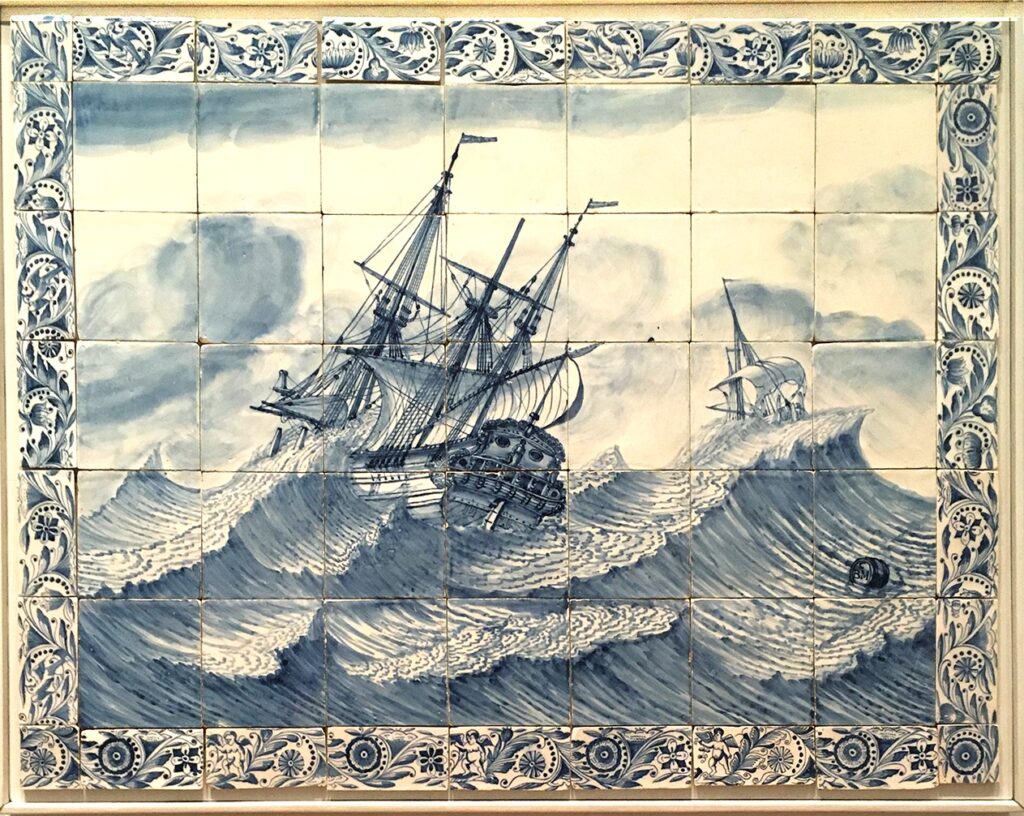
Marine, late 1600s by Cornelis Pietersz Boumeester for Delftsevaart tile factory. Purchased with funds contributed by Fitz Eugene Dixon, Jr. 2018-23-1
Dutch naval power rose rapidly in the late 1500s and the Netherlands dominated global commerce during the 1600s.
In the third-floor galleries at the Philadelphia Museum of Art., curator May Anne Justice shared with us her beautiful installation of Dutch tiles organized by themes. I have reproduced the gallery labels and images of the tiles here in “E-News.” I have added in brackets the catalog andpage numbers from Ella’s 1984 exhibition catalog, some of which is quoted the the gallery labels.
Reference: van Dam, Jan Daniel, Pieter Jan Tichlar and Ella Schaap, Dutch Tiles in the Philadelphia Museum of Art, Philadelphia, 1984.
A special thanks to Sally Malenka, Senior Objects Conservator at the Philadelphia Museum of Art, as well as to her colleague, Mary Anne Justice, curator, who worked together with Ella Schaap on the museum’s Dutch tile collections for 40 years. Mary Anne has continued to build the collection of Dutch ceramics and served as our host when Sheila Menzies and I visited the museum on May 13, 2024 to present the Tile Heritage Award to the museum’s Conservation Division and European Art Department in recognition of the late Ella Schaap.
Joseph Taylor
“In the 1500s about half the population of the Netherlands— a low-lying coastal country— lived in cities near water. Homes were damp, and even the open fires used for cooking and heating would not dry them. So when Dutch potters started making ceramic wall tiles, they answered the call for a waterproof, easy-to-clean surface that would protect Dutch residences. Who knew that this practical solution would give rise to a thriving industry that created millions of ornamental wall tiles for generations to come?
“As the Netherlands became more prosperous in the 1600s, people could afford to decorate with tiles— an idea that caught on in neighboring countries. Dutch tile manufacturers invested in new production and decoration techniques, soon dominating the market in Europe, Asia, and beyond. People sought Dutch tiles for their superior quality and artistry, placing them not just in their houses but in public buildings and palaces.
“Dutch artists painted the tiles with themes from the life and culture of the Netherlands. For design and color inspiration, they drew on a variety of sources: bold colors and intricate motifs from Italian ceramics, blue-and-white patterns from Chinese porcelain, and purple and lavender decorations from French decorative arts.”