

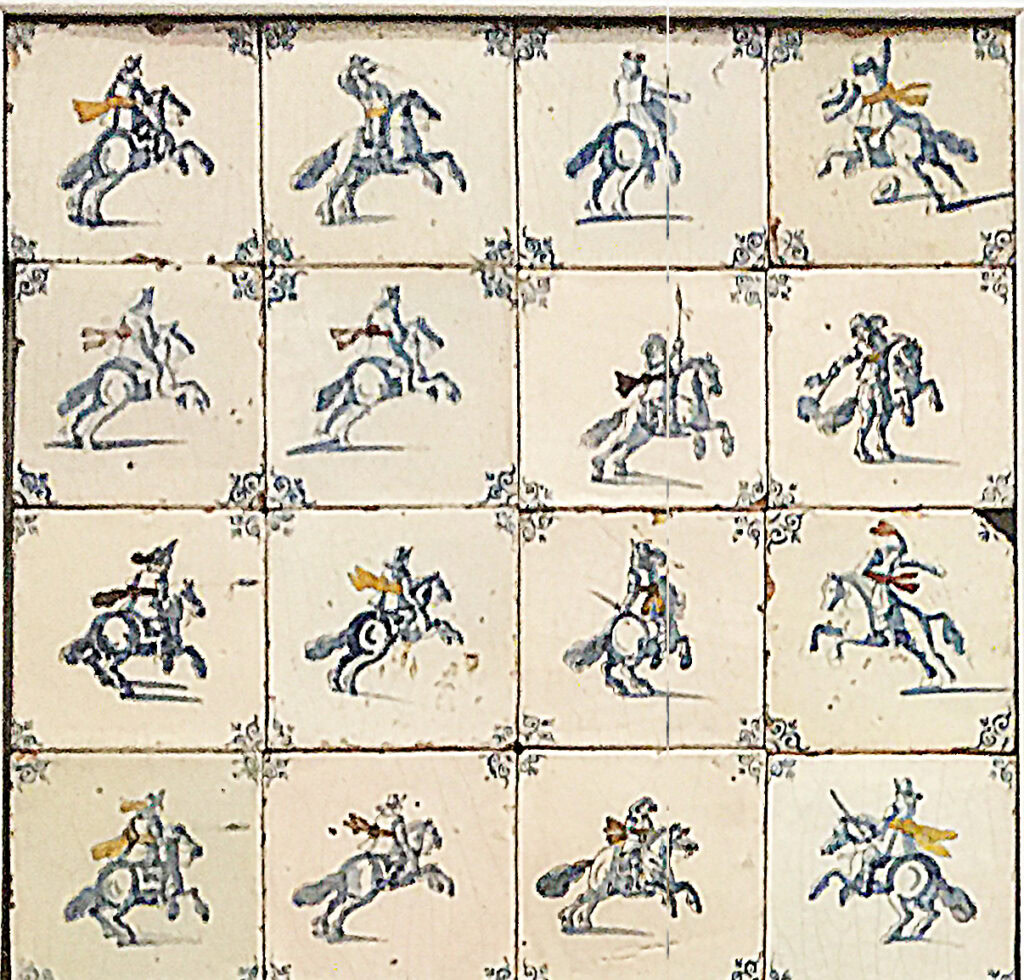
Cavalry
1640-1680. Gift of Anthony N. B. Garvan Light cavalry soldiers and dragoons on rearing horses charge across these tiles. With one exception, they all wear yellow, red, brown or orange sashes around their waists. [cat. # 162, pp. 130-131]
“Images of soldiers and militiamen gained favor as a tile decoration during the Dutch fight against Spanish rule from 1568 until the Treaty of Munster in 1648. After gaining independence, the new Dutch republic drastically reduced its army and images of soldiers were replaced by those of horsemen.”

Pikeman and Musketeer
1580-1620. Gift of Antony N. B. Garvan The pikeman, sporting a beard, mustache, and green plumed helmet, thrusts his weapon. The musketeer, in an orange plumed helmet, points to the left, holds a musket rest, and supports a musket on his shoulder. [cat. # 152, p. 123]

Roman Soldiers and Saracen Bowmen
1590-1625. Rotterdam Gift of Antony N. B. Garvan The archers wear turbans, billowing scarves, and kaftans, and carry quivers filled with arrows. The Romans sport plumed helmets, cuirasses, and sashes, and carry modeling and with blue shadows that create bold chiaroscuro patterns. They depict Saracen bowman and Roman warriors outlined in blue and black, with shields, short swords, and lances. [cat. # 153, 153a, pp. 124-125]

Pikemen and Musketeers
1625-1650. Gift of Mrs. Francis P. Garvan Set within bracketed frames, soldiers drill with pike and musket. [cat. # 156, p. 127]

Pikemen and Musketeers
1625-1650. Gift of Edward W. Bok; gift of Mrs. Francis P/ Garvan Swaggering pikemen and musketeers, many wearing plumed hats, decorate these tiles. [cat. # 159, p. 128]

Drinker, Musicians, and Peddler
1625-1650. Gift of Edward W. Bok A drinker raising his arm in a toast; a bagpiper and a seated musician and a peddler with his wares on a tray strapped around his neck. [cat. # 112, p. 99]

Ladies and Men
1625-1650. Gift of Mrs. Francis P. Garvan Closely allied to the popular series of fashion published in Northern Europe at this time, the tiles document with great detail the style consciousness of the prosperous 17th century Netherlanders. [cat. # 115, p. 100]

Villagers (Pilgrim Tiles)
1625-1650. Gift of Mrs. Francis P. Garvan Tiles of this type have become known as “Pilgrim” tiles because of their similarity to a group found in a house in Amsterdam thought earlier in the 20th century to have been the residence of Pilgrims who afterward sailed on the Mayflower to Plymouth. [cat. # 109, p. 97]